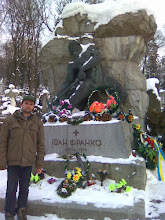
Sunday, 31 May 2009

Young Belarus and the BBC .

When perusing Charter 97's website and the photos of trendy Young Belarus activists I noticed that in the one above was Polina Kurianovich ( third from left ) who featured in Lucy Ash's Crossing Continents documentary on Belarus for BBC's Newsnight and featured in the article 'Lukashenko's Young Challengers ( Monday, 4 August 2008 ).

The documentary was outstanding in failing to question why these activists were actually opposed to Lukashenko.

Polina seems to spend most of her time getting into trouble with nasty and surly Belarusian cops who use all kinds of legislation to stick the students in court for breaches of public order. Along with her brother Pavel, Polina seems to think putting EU flags around Minsk is some kind of heroic gesture that will bring the regime down..

Nor did Ash think it strange that Polina's father shown above with his daughter sees it as perfectly normal to walk about his home with combat fatigues on.

"It's not against the law to carry a flag. What is wrong with wanting to be part of Europe?" he says
"My daughter is very well brought-up and those cops lied about her swearing to get her into trouble - what a disgrace for our police
He tells me that he used to be a policeman himself but resigned because he felt there was too much corruption in the ranks."Most of our police don't want to fight crime or take on the bandits. They prefer to spend their time repressing young people and stopping them from going on demonstrations."

Whilst the police do pointlessly harass demonstrations, it's nonsense to pretend that the supposed corruption of the police in Belarus somehow necessarily means the regime of Lukashenko is completely based of bayonets alone because of that.

Corruption is rife in the police across Eastern Europe and in former parts of the Soviet Union, not least because the police get paid so little. Which is probably why the Belarus police get riled by privileged students histrionically parading themselves in Minsk in fashionable clothes.

Ash never challenged Kurianovich's assertion that the police prefer to spend their time on demonstrators instead of dealing with 'real criminals' nor pointed to Lukashenko's governments crack down on human trafficking and the sex trade. After all, the level of crime in Belarus is very low.

Mr Kurianovich shows me a yellowing ID card which shows he took part in the massive clean up operation after the Chernobyl disaster. He tells me his father was a partisan in World War II.

Well, there were many partisans and not all of them were fighting for the Soviet Union and some were prepared to come to terms with Hitler if it meant they could avoid being recolonised by Stalin's Red Empire.

The film was also odd as it seemed to portray Belarus at times as some near approximation to a nightmare totalitarian state.

The film begins with bleak pictures of the empty and impeccably clean streets of Minsk, views of monumentalist Soviet architecture, snapshots of Lenin's statue and extended footage of Lukashenko appearing on huge video screens overlooking the celebrations and mass parades commemorating the end of World War Two.

The film focuses on the fretful experience the wife of an arrested dissident whose exact offence which , even if cooked up by the KGB, is not entirely clear.

The viewer is not really given that much inside knowledge as to how or why the system is operating as it does other than to imply most Belarussians are too cowed and frightened of the post-Communist world to be able to think beyond it.

Yet other later shots of Minsk in the film then show lots of fairly well dressed citizens going about their business, shopping and enjoying the economic boom with growth of 8% per year and construction sites springing up all around.

The message being that political freedom and free speech is deemed not so important if the majority feel economically comfortable enough and those who keep the flame of liberty alive are prisoners of conscience. As the BBC website article accompanying the video suggests.

Being a young opposition activist in today's Belarus is a dangerous and sometimes lonely job......Most people in the Belarusian capital have been drinking beer at pavement cafes or strolling through parks, enjoying the Independence Day holiday. Polina has spent the weekend behind bars. She was arrested after plain clothes officers found some European Union flags in her rucksack when she was on her way to a concert and firework display.

Clearly, Belarus is a somewhat dreary and repressive place. But Polina and Pavel do not seem particularly poor. Nor do they seem to be in danger nor have they been fired on with rubber bullets as protesters in Georgia have been under Saakashvili whose Rose Revolution of 2003 was backed by the West and George Soros.

Yet it would be interesting to know whether such opposition is really about the money those like Kurianovich are though to receive from from abroad or if in her case she is just opposing the system out of conscientious objection to human rights abuses which do go on in Belarus.

In the BBC film I did not get any sense of real anger nor even any analysis from this girl about the nature of the system.

Only that as 'Pro-European activists' they should stand up against increasing authoritarianism, the domination of their big Russian brother, and be more 'pro-European'. Why no explicit mention of the political prisoners or missing journalists ?

So not only have Young Belarus have not only decided Lukashenko must go, even if most Belarussians support him despite electoral irregularities but have already decided Belarus will join the EU. Before Belarussians even give their consent to that.

"The state is becoming more authoritarian," says Pavel Kurianovich. "But someone has to do something - if not us, then who? The absolute majority is unhappy but most people just complain in their kitchens. They are afraid to act."
Most Belarussians just do not seem to give a hoot about these activists because Lukashenko is delivering prosperity and resent external meddling to bring about regime change, making it both futile and counter productive

If that prosperity came to an end they might become 'Pro-European' but in the meantime they are on their own because, as the film itself hints, enough Belarussians are satisfied and it is not worth getting into trouble. But the BBC report then claims,

The climate of fear in Belarus intensified after the presidential elections two years ago. In March 2006 huge crowds gathered on October Square, demanding a fresh vote after President Alexander Lukashenko was declared winner by a landslide in a poll condemned as unfair by many local and international observers. Many hoped that Belarus might emulate the non-violent regime changes in other former Soviet republics. As people huddled in blankets and chanted to rap music, it seemed a carbon copy of the Orange Revolution in neighbouring Ukraine.

There is no climate of totalitarian fear in Belarus. Simply indifference if not hostility to the way Young Belarus is regarded as representing the interests of outside economic interests.

Principled dissidents living under the Cuban dictatorship like Oswaldo Paya have pointedly refused to accept foreign money because it only helps the Castro's discredit the opposition. Paya also stresses the need to preserve some of the benefits Castro brought in health and education.

Mark Almond, an Oxford Don and no trite hard left hack propagandist, wrote for the Guardian in relation to Lukashenko's election victory ( Less Bizarre Than It Seems March 26 2006 ), that Lukashenko's Belarus was not some nightmare Stalinist theme park and that,

.....human-rights charges lack traction because the western-backed opposition has offered no economic platform, just echoes of these western allegations against Lukashenko.

Although the west has never batted an eyelid about accepting a 97% vote obtained by a favourite such as Georgia's rose-revolutionary President Saakashvili, at first sight four-fifths voting for one candidate seems hard to credit. But if you look at the socioeconomic reality of Belarus and compare it with its ex-communist neighbours, as Belarussians do, then the result is not so bizarre.

No communist-era throwback, Belarus has an evolving market economy. But the market is orientated towards serving the needs of the bulk of the population, not a tiny class of nouveaux riches and their western advisers and money launderers. Unlike in Georgia or Ukraine, officials are not getting richer as ordinary folk get poorer. The absence of endemic corruption among civil servants and police is one reason why the wave of so-called "coloured revolutions" stopped before Minsk.

But even if the government in Minsk is not corroded by corruption, its opposition depends upon support from abroad. If people resent anyone for getting rich quick undeservedly they resent the opposition types who receive lavish subsidies from the west to promote civil society and flaunt the latest iPod.

The irony of the west preaching civil society and shock therapy at the same time is that you cannot have both. Western advisers made economic transformation a priority, but wherever their advice was followed it was poverty, not pluralism, that resulted. Across the old communist bloc "shock therapy" enriched a few dozen oligarchs and their foreign economic advisers, but the mass unemployment it caused and the collapse of public spending it demanded smashed the foundations of the civil society emerging under Gorbachev.

By protecting Belarus from the ravages of free-market fundamentalists and delivering economic growth and prosperity for the mass of Belarussians, Lukashenko has sown the seeds of a pluralistic society far better than by handing the state's assets over to half a dozen cronies of western advisers.

Belarus is far from perfect, but it is a country where masses of ordinary people are getting on with life and getting a bit better off. That is why Lukashenko inspires fear and loathing in the thinktanks and foreign ministries of the west. By saving Belarus from mass unemployment he set a terrible example. What if the neighbours tried to copy it?

It's about time the BBC stopped being led along only by clients of these think tanks and NGO groups and tried to maintain objectivity on the situation in places such as Belarus and reporting the reality, both the brutality of the state and the fact it is not Stalin's USSR.

Thursday, 21 May 2009

Young Belarus. Old Geopolitics ?

The use of the Internet to propagate 'democracy promotion' in strategically valuable and geopolitically important nations in the post-Soviet republics has been a major tool for activists hired to bring about regime change.

Charter97 is one such organisation that has been set up to mould opinion in the West with regards keeping up the image of there being some titanic struggle for freedom against Lukashenko's "police state".

Yet unlike Solidarnosc there is no widespread popular support for Charter 97 nor are there free thinking leading intellectuals at the helm of it: there is no genuine mass activism or strikes but just the relay of weirdly staged 'events' on the streets of Minsk.

There's also a video clip of Vaclav Havel proclaiming that 'Freedom will Prevail in Belarus' and Mick Jagger with his 'Appeal to the Belarusians'. Designer revolutionaries clearly need the benediction of he who sang Street Fighting Man.

Yet the Charter 97 website is full of photos of somewhat bored looking young activists doing things before cameras and with the Belarussian police looking as surly and annoyed as the Metropolitan police were with the reedy and shrill provocations of the G20 protesters in London.

The crucial difference is that whilst G20 protesters were protesting against capitalism, young Belarussians are protesting for it, though they never mention the 'C' word anywhere on the website but prefer to concern themselves with freedom from repression

Young Belarus activists never try to outline what economic plans that would follow should Lukashenko be removed. Nor who would benefit from a policy of extensive privatisation if not Lukashenko's kind of post-communist followers.

For though the formal trappings of Communism remain, Lukashenko's regime is moving towards the Party sponsored capitalism of a nationalist and statist form where 'stability' and independence between both the West and Russia is the goal.

If the record in the rest of Central and Eastern Europe after 1989 had been learnt, then the benefactors would certainly not be the majority of ordinary Belarussians above whose heads this confrontation between pro-Western idealists and crony capitalists is taking place.

This is the reason why they are not taken seriously within Belarus amongst most of the population is that it's well known that Young Belarus was set up and funded by the billionaire financier and philanthropist George Soros.

Back in 200o the success of Otpor in Serbia, also funded by Soros, in toppling Slododan Milosevic led Soros and his Open Society Foundation to believe the model could be copied across Eastern European nations still languishing under 'dictatorships' not open to the global investment community.

Whilst the manner in which Soros and Western NGO backed political fronts operate should not be cause to rationalise the existence of the unpleasant and repellent way authoritarian post-communist and nationalist strongmen act, the history behind regime changers is hardly edifying.

For it is through identifying the interests behind the Young Belarus front activists that the nature of 'change you can believe in' will, of course, lead to the same imposition of 'shock therapy', depressive macroeconomic policies and mass unemployment.

For Young Belarus is about the US and Soros implementing what Soros calls in Underwriting Democracy the "Americanization of Eastern Europe."

Through his education programs he began to establish a young vanguard elite of potential new leaders. These Soros Foundation-educated young men and women are eager to carry out the functions of 'influence agents' who will press for change.

Candidates are recruited on the basis of their fluent knowledge of languages and their ultimate aim is to gain power and make inroads into the bureaucracies of countries targeted as potential sites for control by Western multinational corporations.


Where there are limited opportunities for such people that do not involve giving in to the control exercised over the economy by Lukashenko, it's obvious why many Belarussian youths feel frustrated at their society.

Many of them have parents who are virulent nationalists who have yet managed to square their love of country to support economic policies, in so far as they even understand neoliberal theories, that would impoverish their compatriots perhaps even more than they are already.

It was in order to avoid the terrible poverty that ensued in Russia during Yeltsin's presidency, which despite rigged elections, warmongering, corruption and so on was supported by Soros, that Lukashenko was able to exploit the anxiety to gain his authoritarian power base.

The fault for the fact Belarus has Lukashenko is exactly because Western NGOs, neoliberal shock therapists and the IMF tried to impose the idea that only by moving to American style capitalism overnight in societies where there was no basis for it was the only alternative.

Unfortunately, Lukashenko has proved that there is an alternative to the idea that there is no alternative to neoliberal capitalism and the aspects of authoritarian rule young Belarusians now complain about are the consequence of that.

In Latin America, once casually assumed to be the USA's sphere of influence, the same has happened with the rise of Hugo Chavez's '21st Century Socialism' and the CIA, the National Endowment for Democracy and other NGO's have consistently tried to coalition opposition to him.

Now Eastern Europe and Central Asia is the 'New Latin America' in this respect and has been shown in the the way the USA shifted the focus of it's 'destabilisation' and regime change policies from it's traditional backyard across the Atlantic.

For states such as Belarus are disliked not because they are authoritarian, though it makes for good propaganda. As with Venezuela, with whom Belarus has developed bilateral trade ties, it is because of their connection with US energy security and oil interests.

On the contrary, nations like Belarus are considered strategic spaces on what Brzezinski calls The Grand Chessboard whereby projecting US power through Eastern Europe into Central Asia will ensure control of the oil pipeline routes.

With the demise of the Soviet Union, Latin America is no longer regarded as important to the USA's geostrategic interests as it once was whereas control of the Eurasian 'World Island' is a key driving force behind Brzezinski's writings on foreign policy.

The shift in emphasis was shown not only in the projection of US power into the Balkans during the NATO bombing of Serbia in 1999.

It has also occurred with the shifting of certain personnel entrusted with carrying out dirty wars against left wing regimes in Latin America to positions in Eastern Europe.

The responsibility for creating Young Belarus and coordinating NGO opposition to Lukashenko is the legacy of the US ambassador, Michael Kozak, appointed by Clinton in April 2000.

Kozak who
was a key activist in the anti-Sandinista campaign under Reagan and Bush Sr and an expert in ensuring Washington's favoured candidate wins elections as he admitted he did in Nicaragua in 1990.

Kozak worked with the Soros-sponsored "Internet Access and Training Program" (IATP), which was busy "creating future leaders" in Belarus amongst the young out of which Young Belarus came.

Clearly, the Young Belarus activists who rightly protest about 'political prisoners' see no irony in doing so at the behest of a superpower and under the influence of political figures and financiers whose policies have caused targeted assassinations and murder in Latin America.

The imprisonment of 'entrepreneurs' is wrong ( though the exact circumstances in which they have been imprisoned is not mentioned ) and small businessmen have legitimate grievances against the restrictive nature of Belarussian legislation on them.

Yet Soros and the US backers are not that interested in small businessmen nor entrepreneurship but in corporate finance, asset stripping, and reaping huge dividends from the corrupt privatisations that have been common elsewhere in Eastern Europe.

The problem with Lukashenko is that he occupies a position in a strategic nation on the pipeline map and that he has not privatised Belarus' valuable oil refining industry into the safe hands of Western investors who can then finance the governments they want.

That's precisely why Lukashenko's regime is portrayed as a nightmare Stalinist theme park whilst Saakashvili in Georgia who came to power through the Soros funded 'Rose Revolution' of 2003 is not criticised when he uses far severer police measures to attack political opponents.

That came to a head in Tbilisi in November 2007 when protesters were dispersed with rubber bullets, tear gas and batons and beatings that make Lukashenko's cops look very tame, not to mention the political prisoners, rigged election, torture and condition of Georgian prisons.

Young Belarus, for all the pretence of international solidarity with victims of oppression never have anything to say about that for the simple reason that this would be 'off message' and would go against the agenda of Soros who actually substantially funded the Georgia police.

As Mark Almond wrote in his essay The Strange Silence of George Soros ( 14 November 2007 )

On 22nd March, 2004, Saakashvili’s long-term aide, Kote Kublashvili, the administrator of the secret fund, told the Georgian Times, that the new fund’s “main attention will be focused on the employees of the law-enforcement agencies.”

In the last reference I can find to the Georgian fund by Mr Soros on the BBC Radio 4 “Today” programme on 31st December, 2005, Mr Soros still explicitly included the Georgian police among the recipients of his money.

As the Russian journalist and Saakashvili admirer, Pavel Felgenhauer pointed out just before the Georgian special forces gave the protestors a taste of the “black aspirin” on 7th November, Georgian officers now get up to US$1,000 a month.

That makes obeying orders very profitable if a little costly to the Western taxpayers and Mr Soros who have picked up so much of the tab.

The doublethink is stark: Young Belarus activists are there to fight a police state whilst their funder has funded brutal police actions elsewhere in nations where the revolution they are calling for has already supposed to have taken place.

And this is what is known as democracy promotion' ?

Monday, 18 May 2009

Thoughts on Market Leninists.

One of the most curious ironies of Central Eastern European politics post-1989 has been the way the Communist Utopian project has mutated along with its followers into a militant neoliberal capitalist creed.

Another irony is the way that there has been convergence between nations of the former Communist 'Eastern ' bloc and Britain with regards the growing power of unaccountable and unelected NGOs and corporate capitalist vanguard elites who demand 'reforms' that benefit the 'global investment community' over the demands of their citizens.

Though they pose as 'post ideological' technocrats they are very ideological in believing in aminimal role for the state and a democratic centralist approach to politics. New Labour in Britain is, like most leftist parties in Central and Eastern Europe such as Hungary's MSZP, wholly 'Market Leninist'.

This new elite believes it in a modern democracy the aim is not representation as such but 're-presentation' where the people must be subject to forms of manipulation, persuasion and control that gets them to acquiesce in the system through spinning illusions of easy wealth and infinite progress if there is the will to believe.

So long as the people have their bread and circuses, the elite can do what they see is right, even if it means appointing non elected politicians to positions of power, such as Lord Mandelson in Britain or Hungary's new PM Gordon Bajnai who has not been elected by Hungarian citizens.

As Neil Clark has written,

Bajnai became prime minister due to the support of the neoliberal SZDSZ party (Alliance of Free Democrats), who despite having the support of only 1 per cent of the electorate, according to recent opinion polls, hold the balance of power in parliament. Bajnai is not a member of any political party, but a friend and former business partner of both Gyurcsány and the SZDSZ leader, János Kóka.

Other unelected “experts” in the new government include finance minister Peter Oszko, formerly head of Deloitte Hungary; economy minister István Varga, the former head of Shell in Hungary; and minister of transport, telecommunication and energy, Peter Honig, the former CEO of the airline Malev.
Though following neoliberal debt fuelled consumerism has brought Hungary closer to bankruptcy, this elite now believes that it must push on with reform, which means cutting public expenditure and disregarding the referendum on 2008 in which Hungarians voted against tuition fees and doctor visit fees.

The SZDSZ now demands a “government of experts” to make large cuts to public expenditure, despite the fact that the attempt to shift the burden of the public debt across to the private sector has accrued ever huger debts than were necessary in the first place without achieving much in the way of creating any longer term or lasting infrastructural resilience to economic instability.

Such crisis management is what Balcerowicz, Poland's first transition economist in 1990, called 'extraordinary politics', where the conjuncture of an economic crisis with a potential political backlash is regarded as an opportunity to ram through measures that re-engineer society, destroy rival centres of power e. g unions and entrench elite power.

After all, the neoliberal experiment that Balcerowicz unleashed upon Poland had been deployed by Margaret Thatcher in Britain and before than in Pinochet's Chile following the coup in 1973 which overthrew the democratically elected but unstable and Communist influenced government of Salvador Allende.

The ideological can be very anti-political as it obvious with the history of Communist and Fascist totalitarianism and as is evident with the neoliberal globalism pursued by liberal left elites whose Positivistic creed of a government by experts has appealed as much to Communists as it has to Fascists and Neoliberals.

Positivism was an ideological influence on the Chicago Boys the market fundamentalists who engineered the recovery of the health of Chile through 'savagely cutting government expenditure ( except on the military) , dismantling the welfare state and producing a boom of sorts for the top 40% of the population' ( Mark Almond ).

Such 'success' created by Thatcher in 1980s Britain ( the Chilean experience is conveniently forgotten by most tubthumpers for neoliberalism in Central and Eastern Europe ) is one clearly admired by the elites in Central and Eastern Europe as a key part in creating an ever expanding sphere of liberty.

For Soros' and his Open Society Foundation's operations tend to prove, promoting neoliberalism through coups have not lost their appeal, as Soros' support for Saakashvili's coming to power in Georgia during the mass media staged and choreographed 'Rose Revolution' of 2003 demonstrates.

As Mark Almond commented,

.......the west's favoured candidate won 96 per cent of the vote to replace him. Generous George Soros stepped in to pay the salaries of the new president's ministers and policemen in Georgia. Soros's business partner Kakha Bendukidze became economy minister.
Such a philanthropic interest in law enforcement meant Georgian officers now get up to US$1,000 a month

That makes obeying orders very profitable if a little costly to the Western taxpayers and Mr Soros who have picked up so much of the tab.
Overcome with enthusiasm for Saakashvili's regime, the police resorted to draconian techniques been used to disperse protesters in Tblisi in November 2007 including tear gas, rubber bullets, beatings and the use of special forces to smash up the Imedi TV studios.

Such heavy handed policing was not commented upon by Soros who remained silent whilst any evidence of heavy handed policing in Lukashenko's Belarus is seen as evidence of a nightmare Stalinist tyranny that could not happen in a liberal democracy, with the protesters depicted as heroic youthful democrats and not adolescents being given cash by Western NGOs.

In Hungary when protesters gathered in Budapest in October 2006 to rally against Gyurcsany following his admission that he had lied morning noon and night about the state of the economy just to get re-elected, the protesters were smeared by New Labour allies such as Denis MacShane as being far right nationalists and Fascists.

This is doublethink world is possible where corporate advertising, Leninist vanguard politics and globalist Utopianism have come together and in which Western societies have been taken over by an elite intent on terminating the development of their culture and nations and giving them over wholly to frantic consumption.

Zizek calls these elites 'liberal communists', partly because as a 'real' Leninist he detests the manner in which internationalism has been conscripted to serve global capitalism and to reduce the revolutionary truth project to 'inauthenticity'.

Yet Zizek has a point when he writes about,
Nietzsche's old opposition between active and passive nihilism. Active nihilism, in the sense of wanting nothing itself, is this active self-destruction which would be precisely the passion of the real - the idea that, in order to live fully and authentically, you must engage in self-destruction. On the other hand, there is passive nihilism, what Nietzsche called 'The last man' - just living a stupid, self-satisfied life without great passions.

The policy of massive private debt fuelled consumerism depends upon it to dampen down citizens to passive consumers nihilistically abdicating all responsibility for themselves and for others because they 'just wanna be happy' and because they cannot do anything about the world.

The fear of the liberal left elites has been that passive nihilism is a side effect of prosperity and that if the masses were not diverted by consumer spectacles and the frantic pursuit of satiety through shopping they would be frustrated and fasten on to unpleasant ideologies. The children cannot be trusted.

Aldous Huxley was prescient in his when he wrote in 1946 a new foreword to his Brave New World when he wrote, in a way which is very applicable to the liberal communists,

The people who govern the Brave New World may not be sane (in what may be called the absolute sense of the word); but they are not madmen, and their aim is not anarchy but social stability. It is in order to achieve stability that they carry out, by scientific means, the ultimate, personal, really revolutionary revolution........

A really efficient totalitarian state would be one in which the all-powerful executive of political bosses and their army of managers control a population of slaves who do not have to be coerced, because they love their servitude.

Whilst former dissidents do complain about consumerism they tend to delegitimise protest against the liberal communist elite by framing the entire opposition as nationalistic and populist, especially Michnik in Poland complaining about Kaczynski's PiS, lustration, the dangers of 'theocracy', harping on about Katyn, the Second World War etc in 'unproductive' ways.

Such nasty symptoms of 'instability' are anathema to the idea of efficiency as, though Kaczynski' and populists are deeply unpleasant, they are also idiotic and so by lavishing so much criticism on them, Michnik can deflect attention away from the democratic deficit as power leeches away from the citizens of nation states to unaccountable transnational networks of power.

For there is no alternative to the neoliberal global order which has an Providential right to rule according to the dictates of History which is on the side of the liberal communists, especially those who admire the dissident Bolshevik Leon Trotsky.

Trotsky influenced a whole generation of politically motivated students who reached adulthood and were active in the 1968 revolutions.

For MacShane writing in 2007 Poland 'must get over its demons' and so discussion on the impact of the shock therapy and the Balcerowicz Plan, in fact any intellectual honesty or objectivity with regards Poland's recent history is simply not to be discussed.

Poland should be Europe's happy country. Its economy is growing at three times that of Britain's or France's and it has more inward investment than any European nation but Britain. Its cities are booming, with new skyscrapers, restaurants and one of the youngest populations in the old continent. Flights to the UK are crammed both ways. Poland's economic and civil society is booming, but its politics is troubling.
No mention then of the 25% unemployment in Poland in 2003 before Britain opened it's labour market nor the poverty that blighted it as a result of imposing Thatcherite policies on Poland, deindustrialising whole swathes of Silesia.

Instead of dealing with that legacy, MacShane complained,

They are busy burying the democratic revolution that ousted communism after the Solidarity movement rose in Gdansk 27 years ago this month. The heroes of Solidarity, like Lech Walesa, the journalist-activist Adam Michnik, or the liberal historian and MEP, Bronislaw Geremek, are being sidelined along with left-over communists.

Well, the victory of Solidarity was not a 'revolution' but more a 'refolution' in which the Communists and Solidarity agreed to share power and draw a line under the past, which, when set against the economic shock therapy led to feelings of betrayal.

There were also left over Communists who hated 'really existing socialism' who MacShane worked with when he supported KOR in the 1980s who have had such opinions, such as fellow KOR members who now spit with fury about how they were co-opted to fight merely for the restoration of capitalism.

If history is written by the victors, then clearly there is little space for those in the Gdansk Shipyards, the mines and the factories, who were liberated by being freed from the tyranny of employment.

Thus for Michnik there are essentially 'two Polands', the one which is liberal and cosmopolitan and that he identifies with himself as a historical actor and the other ethnic nationalist Poland which appeals to the 'losers' who turn to right wing populism.

Yet despite the fact that right wing populists exploit the grievances of the 'losers' who expected Solidarity to ensure better working conditions and a greater role for the Catholic Church, Michnik and MacShane use that to conflate oppositionists as ethnic nationalists.

"Nativists" and "isolationists"who oppose deployment of Polish troops in Afghanistan and Iraq can be written off as nothing more than anti-internationalists who really just distrust the sinister role of Trotskyists like Michnik because he's a 'rootless cosmopolitan'.

Not because they could possibly have sincere and deep reservations about neoconservative foreign policy or because the actual facts pertaining to the dangers of imposing democracy at the barrel of the gun.

Ironically, though Michnik's politics is as much determined by the mentality instilled through having lived under Communism as that of the Kaczynki's who he correctly sees as using lustration laws to scapegoat 'collaborators' who are deemed responsible for Poland's misfortunes since 1989.

Yet it's pure partisan hyperbole to pretend that Kacyznski's government could have launched a 'coup' or that lustration is similar to the witch hunting policies of General Mieczeslaw Moczar's 'Partisans'.

For it was Moczar used the celebrations of Polish officials and Army officers at Israel's victory in the Six Day War in 1967 to link Zionism with dissidence.

It was that and Moczar's ability to portray Zionism as anti-Sovietism along with the suppression of the performance of Mickiewicz's Dziady at the National Theatre that spurred Michnik into protest.

More than that Moczar's witch hunts and purge of Zionists allowed Michnik to see politics in the stark binary terms between the Poland of liberal democratic revolution stretching back to 1848 and between the national communists who had inherited the concept of an ethnically defined Poland pushed by the pre-war Endek.

The romantic liberal revolutionary creed of Mickiewicz appealed to Michnik because he had the desire to project himself as some world historical actor on the international stage. But it was also because Dziady contained prophetic visions of the destruction of the Tsarist Empire.

Yet though daringly anti-Establishment until 1989, Michnik was receiving CIA stipends that encouraged him to see Soviet Communism as an Evil Empire opposed to the USA whose model of democratic revolution against Imperialism made it an anti-Imperialist beacon of liberty.

That ideology has proved useful in advocating the role of Poland as a erstwhile client state of the US Empire and forthright support for Zionism and Israel no matter what it does. The messianic aspect of Michnik's creed has lent itself well to support for such outposts of liberty amidst the surrounding darness of totalitarian Islamist theocracy.

As with MacShane, a member of the Labour Friends of Israel group and the Henry Jackson Society, the aim is to use the anti-semitic smears to discredit anyone who is opposed to the unconditional support given Israel which is at least partly about securing geopolitical control over oil and procuring defense contracts and arms sales.

For it needs to be remembered that the anti-Zionist campaign of 1968, that Michnik uses to claim that national communism was as inherently as anti-semitic as Arab nationalist movements, the PLO etc, was primarily about a change in line from Moscow, as arms sales and support for Israel from the Soviet bloc had been a feature in Cold War politics

Which points again to the doublethink that is at the core of the Liberal Communist mentality. That of total subservience to Washington on an ideological basis.

Like MacShane's such politics is now relentlessly Establishment but positions itself as being radically oppositional, with polemics peppered with the pseudo-literary poses of those who flatter themselves that they are in the 'decent left' tradition of George Orwell.

The irony is that the Michnik's fervent belief Transatlantic bloc and closer integration of US command structures with Eastern European elites is far more messianic a notion than that conceived of by the footling Kaczynski's who just hate Russia and close to Orwell's vision of Oceania in 1984.

Michnik seems to have failed to understand Orwell's work, whilst appropriating the anti-totalitarianism because, rather like Christopher Hitchens and other 68ers, he likes to select those chunks of literature that can be used for propaganda purposes, somewhat like Trotsky did.

Michnik's debt to Trotsky is clear again in his belief that morality depends on political expediency and that this is fine so long as the historical cause he has identified himself with is the right one, a source of strength when stading 'alone' against Stalinist totalitarianism but that can become a weakness when it hardens into pure dogma.

So Zizek, a Leninist of sorts who harbours messianic fantasies of ideological violence and politicised justice himself, is interesting because he understands how the anti-Communism of certain dissidents is determined by their past life under Communism.

What Zizek sees in Vaclav Havel is equally applicable to Michnik who now supports NATO expansion and the War on Terror whilst remaining silent on the use of torture, the napalm bombing of Fallujah because carried out by the USA which supported anti-communism.

The predominant form of today’s ‘politically correct’ moralism.... is that of Nietzschean ressentiment and envy: it is the fake gesture of disavowed politics, the assuming of a ‘moral’, depoliticised position in order to make a stronger political case. ....

.( They are )....disappointed Leftists, who are convinced that radical change of the existing liberal-democratic capitalist system is no longer possible, but who are unable to renounce their passionate attachment to global change, invest their excess of political energy in an abstract and excessively rigid moralising stance.
So for the 'liberal communists', however, the nihilism into which Europe has descended can only be transcended by the abstract universalism of the global crusade to export Human Rights and market democracies, by military force if necessary.

Though ostensibly political, the aim is anti-political in that it is Utopian, a legacy of the fact so many ex-Trotskyists and radicals like Denis MacShane, Adam Michnik and Gyorgy Konrad have came to prominence back in the student movements of 1968.

The idea behind it stems from the cynical degeneration of revolutionary hopes: what the people really want is not nationalism and religion but consumerism, hamburgers, shopping malls, Ipods and mobile phones, and an End to History.

As Zizek puts it in terms that apply as much to New Labour in Britain as the SLD in Poland or the MSZP in Hungary or, by extension, the People Power or 'Coloured Revolutions' in Eastern Europe,

The idea of a Third Way emerged at the very moment when, at least in the West, all other alternatives, from old-style conservativism to radical social democracy, crumbled in the face of the triumphant onslaught of global capitalism and its notion of liberal democracy. The true message of the notion of the Third Way is that there is no Second Way, no alternative to global capitalism, so that, in a kind of mocking pseudo-Hegelian negation of negation, the Third Way brings us back to the first and only way. Global capitalism with a human face.

Yet whilst liberal communists hope for this New World Order, they advocate selective support for the nationalism of victim nations like the Kosovans or the Georgians because it fits in with the geopolitical designs of US global hegemony, the benign overseer of global revolutionary democratic change.

Nationalism of the sort that challenges this New World Order is Bad, that which supports it or legitimises it is Good. The only basis for political morality has become expediency, whether it advances or not the ineluctable triumph of large power blocs.

Sunday, 17 May 2009

Nick Cohen, the Polish Populist Right and Politically Correct Anti-Fascism.

The following was written in response to Nick Cohen's Observer article today. Cohen is a propagandist whose views are very similar to Denis MacShane and Adam Michnik in 'media framing' discussions about the right in 'Eastern Europe.

An interesting article has appeared by Nick Cohen, the forthright polemicist and tribune of Euro-Atlanticist freedom and liberalism whose position on the Tories scepticism towards the EU he sees as ranging them alongside right wing populists in 'the 'New Europe'.
The Tories will ally instead with the proudly ignorant parties of eastern Europe. Know-nothing chauvinism, sexual and religious prejudices, and conspiracy theories from Europe's dark heart motivate them, but they are against federalism and that is all that matters to Cameron.

In Warsaw, the Tories are as keen to woo the Polish Law and Justice party whose leading figures have variously opined that Obama was the "black messiah of the new left" whose victory marked the "end of the civilisation of the white man" and that "homosexuality will lead to the downfall of civilisation".

In an effort to hold on to its thankfully falling vote, Law and Justice is backing candidates who once stood for the League of Polish Families, an ultra-religious party which combines authoritarianism and Catholicism and announces its admiration for the efforts General Franco made to "thwart communism" and preserve "traditional values".

At least Cameron's Czech allies in the Civic Democrats avoid the old hatreds of Jews, gays and blacks.....the politics of Blut und Boden.....a Catholic
Poland cleansed of the corruptions of modernity.
History is strewn with strange alliances that seem unexpected, not least the support given by Polish left liberals like Adam Michnik whose warnings of theocracy and of the similarity between Kaczynski's PiS and the politics of Franco led him likewise condemn the theocratic fascism of Islamists.

So much so that Michnik gave his unqualified backing to George Bush's War on Terror and mysteriously remained silent on such issues as the use of CIA Prisons in Poland for beating and torturing Islamic 'terrorist suspects'. This is important for the following reasons.

Firstly, if one is going to lambast the right wing parties such as PiS for their use of lustration laws to out 'communists' and collaborate through witch hunts and the use of judicial power one should be aware of a certain hypocrisy in doing so whilst remaining silent on the CIA prisons.

Not least after having supported the 'war on terror' on the basis that no matter what the faults of the USA in the past this should not act as a pretext for rationalising dictatorship and totalitarian regimes simply because they opposed American capitalism.

Secondly, the way Cohen writes about ' the old hatreds of Jews, gays and blacks' he sees as inherent in the Polish populist right ignores the darker side of the Polish liberal left. As Tony Judt had it when writing of Bush's 'Useful idiots'


Adam Michnik, the hero of the Polish intellectual resistance to Communism, has become an outspoken admirer of the embarrassingly Islamophobic Oriana Fallaci

Oriana Fallaci has what some would call controversial views on the role of Muslims in Europe, outlined conspiracy theories no less rabid than the Polish anti-semitic populists about Eurabia and the way Muslims saw a higher birth rate as a way of taking over Europe.

Yet New Labour were only too happy to align themselves ideologically with Polish leftists like Michnik who held these views. For example Denis MacShane who is a great supporter of Michnik from the time he supported KOR, the Worker's Defense Committee within Solidarity.

Unlike certain Muslims from Europe who were actually tortured, I am yet to hear any evidence in Poland where Communists, Jews, homosexuals etc have been beaten and tortured as the consequence of their affiliations, no matter how unpleasant Polish populist politics is.

It's intriguing how those who claim to have been influenced by George Orwell fail to understand what doublethink actually means.

Friday, 15 May 2009

Adam Michnik's Silence on CIA Bases and Torture

Brutal power is equally repugnant whether executed under a red banner or a black one. The belief that there was no rightist or leftist torture, no progressive or reactionary torture, was a fundamental principle we lived by.

The German journalist accuses us of not being concerned about the Bush policies that lead to the suppression of humanitarian principles in international relations. Certainly we are unsettled, but we believe that what leads to the destruction of humanitarian principles is rather the tolerance of totalitarian regimes and the cowardly silence about the crimes of the dictatorships in Iraq, North Korea, Libya, and Cuba.

So opined Adam Michnik in Gazeta Wyborcza on March 28, 2003 in response to a German journalist in Die Tageszeitung who claimed he had become an indiscriminate admirer of the USA when signing a letter declaring his full backing for the invasion of Iraq.

The reasons Michnik gave, that Saddam had aided Al Qaida, was developing weapons of mass destruction and was part of a totalitarian threat to the West, have proved all bogus rationalisations and ones that led not only to a catastrophic war but also to torture.

That was clear even before the invasion of Iraq when the Bush administration had already made it clear that members of terrorist organisations or 'enemy combatants' were not entitled to the protection of the Geneva Convention.

Moreover news this week has come out that Ibn al-Shaikh al-Libi has been found dead in Libya, which became an ally in the War on Terror after he had been subject to torture in Egypt, Jordan, and CIA prisons in Afghanistan and Poland

Though Gazeta Wyborcza has raised continued questions about the use of air bases for the 'extraordinary rendition' and even torture of those captured in Afghanistan, Michnik himself has said absolutely nothing about that.

On the contrary, whilst all this was happening Michnik was ignoring the special tribunals and secret courts, with their language of power similar to that used by the Spanish Inquisition and the Soviet Communists. That could be seen as 'cowardly silence'.

Nothing from Michnik on 'repetitive administration', 'ghost detainees', 'coercive interrogation', 'harsh interrogation techniques' 'detainee abuse' or 'sleep management or the panoply of torture used by the USA which was used by the Chinese Communists and the NKVD.

The reasons for this 'cowardly silence' when Michnik claimed he was critical of the USA over Vietnam and of George Bush's connection to Christian fundamentalists lie in his belief that totalitarianism is similar to theocracy.

There is difference though between those who Michnik believes aspire towards theocracy in the West, the exaggerated claim he has levelled at the Kaczynski twin's former Polish government and their use of lustration laws to witch hunt out Communists, and those in the East.

As the West has successfully separated Church and State, as is embodied within the constitution of the USA and in practice in most European nations, then clearly the real threat to secular liberal Western Civilisation comes from the barbarian hordes from the East.

Though Arabs and Muslims are clearly capable of civilisation to Michnik, hence his support for the invasion of Iraq and the installation of a secular democracy as an exemplary beacon in a benighted region, they are held back by militant radical Islam and Arab nationalism.

Thus both the USA and Russia were fighting against the same theocratic fascist threat in the War on Terror.

That why Michnik in radio interview showed a curiously indulgent attitude towards Russia over 'it's Iraq' in Chechnya which he sees as a 'problem'. Oddly, he thinks that the last 20 years had been 'progressive' and only that the Khodorkovksy case and Georgia proved it's backslide to imperialism.

As he puts it on the view of Russia amongst Poles today,

There is both Russophobia, and a historical complex. There is misunderstanding and fear. A fear not that Russia will go tomorrow into Poland, which we feared in the year of ’81. But for the last 20 years we believed that Russia is going on a good road. None of us thought that a return to imperial thinking was possible. (We – this is the real anti-Soviet Russophiles). With various back holes, through pitfalls, one step forward, two steps back. Therefore people were doubly shocked. The first time – this is the Khodorkovsky case, the second – this is the Caucasus, Georgia. You may ask: 'Why Georgia', and not Chechnya?

Whilst Michnik sensibly rejects the idea Russia is some Neo-Soviet threat he sees Russia as essentially part of the European family of nations and declared that,

I am convinced that the natural interests of Russia and the potential enemies of Russia – these are not Europe and not the USA. They are either Islamist fundamentalism, or China, if something goes awry there.

.....before Russia is a choice: either they’ll go towards some kind of Eurasian ideas, which from my point of view don’t have a real future, practically this signifies isolationism, or the Russian elites will understand that the right place of Russia – this is Europe and Euro-Atlantic Community

......the sense of culture, it’s closer to him to Poland, to America, than to Islamic countries or to China.
That ties in with Michnik's reduction of political morality at least partly down to expediency and to the threats he thinks are more important. As Islamic fundamentalism or totalitarianism in the Arab world menace Western interests, Chechnya is not seen as something worth discussing.

Not least because it was the USA's client Yeltsin and the oligarchs who dragged Russia into the conflict in the first place, a conflict that Putin inherited. So for all Michnik's cant about 'black holes', such facts as that get consigned to the Orwellian memory hole.

Which really does raise questions about what Michnik meant by anti-totalitarianism, not least when he crudely equates privatised networks of Islamist terror with movements like Hamas and Hizbollah, Saddam Hussein's Iraq and Iran as part of one totalitarian threat.

It's clear that Michnik thinks that Islamic fundamentalism is the successor to Nazism and Communism in terms redolent of the staunchest neoconservatives and 'muscular liberals' such as Denis MacShane.

MacShane, a Cold War bagman who supported Michnik during his time in Solidarity in the 1980s. is a forthright advocate of the Iraq War and of a world historical showdown with 'Jihadi Islamists' and a member of the Henry Jackson Society.

This think tank sees Islamism as the linear successor to secular Arab nationalist totalitarianism and that 'regime change' in the Middle East is essential for domestic security within the West against the enemy within, what Michael Gove terms a 'seamless totalitarian threat'.

Michnik's left wing support for neoconservative foreign policy stems from several factors.

Firstly, the demise of the Soviet Union removed the complication of superpower rivalry in the Middle East. As Bernard Lewis put it in The Crisis of Islam (p 77 ),

...had it not been for American opposition, the Cold War, and the eventual collapse of the Soviet Union, the Arab world would have shared the fate of Poland and Hungary, more probably that of Uzbekistan.

Secondly, the need to support Israel as the only stable democracy in the Middle East stems from Michnik's opposition towards the anti-semitism he sees as inherent in totalitarian regimes and their need to demonise scapegoats.

Thirdly, the anti-semitism of Islamists is seen the same mould as the 'national communists' who in 1968 under General Moczar conducted an anti-semitic purge of Jews from public life in Poland for being Zionist agents.

Fourthly, Michnik seems to follow the neoconservative idea that Muslims have adopted migration, along with terror, as the latest strategy in their "cosmic struggle for world domination" ( Lewis ) against the existential enemy that presents itself in the form of the West.

After all, Michnik himself is from a partly Jewish background and sees the recent rise of anti-semitism in Europe as a product of Muslim hate amongst youthful Jihadists.

That fear of a new totalitarian wave from the East has, ironically led Michnik to give support for the rabid 'Islamophobia' of Oriana Fallaci who in “The Strength of Reason” sees Muslims as carrying out a crusade against the Christian West.

In a previous work “The Rage and the Pride,” Fallaci, who had solid Italian anti-fascist partisan credentials, described Muslims as "vile creatures, who urinate in baptistries" and "multiplying like rats" which brought her notoriety and by 2004 a court case.

Michnik was the signatory to The Letter of Solidarity with Oriana Fallaci which, whilst entirely correct to defend her right to free speech, euphemised such unhinged diatribes thus,

Oriana Fallaci has been fighting for the freedom of expression in her work as a journalist throughout her whole life. As we intend to protect the freedom of speech we want to express our solidarity with Oriana Fallaci. Being aware of contentiousness of her latest statements, we still stand against the trial which is infringing the freedom of expression.

Yet Michnik is the first to complain that talk of 'rootless cosmopolitans' really means Jews, something he would hardly describe as merely being 'contentious'. For if Jews were described Fallaci describes Muslims, i.e as rats or vermin, this would be seen as proof of Nazi dehumanisation.

Perhaps Michnik's constant 'cowardly silence' over the USA's policy of torture, as opposed to his outrage at Fallaci's persecution, comes down to the distinction between the worthy and unworthy victims of torture, the fact that those subject to 'extraordinary rendition' were not wholly innocent.

Rather as Christopher Hitchens, a close ideological ally, friend and colleague as Michnik put it, there is no sense in which 'foreign sadists' who were part of a suicidal wave of 'Islamofascists' itching to deny the human right to life by killing other Muslims and Westerners should have full human rights accorded to them.

Even if considerable numbers of those captured in Afghanistan and Pakistan were never charged with specific crimes their assumed cause and allegiances meant that the Geneva Conventions could be ignored and international conventions banning torture flouted.

Clearly, 'brutal power' may seem 'equally repugnant' to Michnik perhaps because only Communist or Islamic regimes practice it but in the war against totalitarian theocratic terror the use of torture in the name of human rights is not torture but something quite different.

( links will appear tomorrow....K Naylor ).....

Thursday, 14 May 2009

Eurovision and the Orange Revolution.

On the subject of the Eurovision Song Contest, it's amusing to remember some of the drivel written during and after the 2004 Orange Revolution in Ukraine about the role of pop music in emancipating the masses.

Most Ukrainian top pop stars who were anything in Ukraine were behind Yushchenko.

Not only Ruslana, but abysmal and doltish rappers like Tartak and Greenjolly who, according to Askold Krushelnycky in his feeble fellow travelling book An Orange Revolution :A Personal Journey Through Ukrainian History, ( pg 293 ),

'composed a snappy tune to go with the lyrics partly inspired by a Spanish revolutionary song but which also wove together slogans chanted at the demonstrations and phrases satirising the gangster ponyatia slang used by Ukrainian criminals and Yanukovych'

The lines Razom nas bahato, nas ne podalaty or 'Together we are many and we cannot be defeated' was sung and played in the Maidan and was voted to represent Ukraine at the 2005 Eurovision Song Contest.

In a pure New Labour moment, politicians danced on stage to the tune, just as in Britain in 1997, New Labour grandees clapped and tapped their feet to D:Ream's 'Things Can Only Get Better', an odious form of pop boosterising bullshit of the sort imported from the US elections.

In Ukraine, this rapping dirge was the perfect kitsch for a faked and staged revolution which was designed to support Yushschenko and Tymoshenko, both of whom have abused their political power and been involved in mass corruption and authoritarianism just as Yanukovych was.

Laughably, Krushelnycky opines without irony on the Eurovision entry hit,

'The song's composers, a local television producer and a sound engineer, did not receive a penny for their hit, although they did not complain'.

Such martyrs for democracy. It's unlikely they are now forming a pathetic queue to get into Eastern Poland to hawk cheap vodka and a few packets of cigarettes or have been reduced to prostitution.

Moreover, as the result of the Orange Revolution unravelled as these wonderful democrats and boundless reformers have now by 2009 proved their real colours,

Ms. Tymoshenko and Mr. Yushchenko are already fighting presidential elections that are nearly a year away and are using their official positions mainly to undermine any decisions taken by the other. In recent weeks, both have issued statements blaming the other for the country's galloping financial crisis, which has seen the hryvna plunge in value by nearly 60 percent, Kiev's main stock market fall by 75 percent, and most banks cease lending or even returning depositors' cash.

Not sure if Ruslana or Greenjolly are feeling the pinch, though. Nor that they have changed their minds about Yushchenko and Tymoshenko.

Eurovision, Kitsch, and Nationalism.

On the subject of the Eurovision Song Contest being politicised by certain Eastern European nation's entrants in recent years, The British 'conservative' politician Harry Phibbs has written,
This year, even before the contest starts, there has been political controversy with Georgia's entry banned because it included lyrics critical of Russian President Vladimir Putin. (The contest is being hosted in Moscow.) The Georgian ambassador to the UK, Giorgi Badridze, says many Georgians were now supporting the UK entry. How very diplomatic. What a pro.

Apart from the fact Putin is not, in fact, the Russian President but the Prime Minister, Badridze is not a joke.

Giorgi Badridze belongs to a rabidly nationalist regime that launched a war on South Ossetia in 2008, raining down death and destruction upon Tskhinvali whilst civilians slept, and it's both pathetic and repugnant that he's using Georgia's Eurovision entry to promote the 'Western' credentials of his regime.

The BBC reported,

The song, performed by the group Stephane and 3G, contains the chorus: "We don't wanna put in, the negative move, it's killin' the groove."

Singer Christine Imedadze told BBC News: "It really means that we don't want people to interfere with our country and to throw bombs on our country.

"The song was really taken well back in our country and in Russia as well. It was just a bit of fun, really.

Which chimed with what Badridze said when he opined that Eurovision had "given into a government which simply lacks a sense of humour" and that the Russian government "just need to relax a little bit," he said, adding: "The song itself was harmless."

Yet there is nothing 'fun' about the way 400 people were killed on Saakashvili's orders, a number which as a proportion of Tskinvali's population would be the equivalent of 70,000 people in London

There is nothing 'fun' in the way kitschy pop has melded with the promotion of nationalist agendas elsewhere in the past.

Despite the ostensible 'kitschiness' of it, music has been a vehicle for promoting visceral nationalist sentiments in parts of Eastern Europe. The most obvious example is Svetlana Ražnatović or 'Ceca' the Serbian turbofolk songstress and wife of Arkan, the ethnic cleansing Serb paramilitary leader and gangster.

Though the tackiness of Eurovision is a bit of a joke for the ironic British, that's far from being the situation in places like Ukraine.

As the Eurovision has expanded into Eastern Europe it has becomes as much about politics as about music or, rather, about 'anti-politics' in the sense that political elites have sought to exploit the hunger for Western consumerism to sell political brands like the Orange Revolution of 2004 through music.

The way musicians from the impoverished Western Ukraine like Ruslana, the winner from 2004, were used to promote the dream that by voting Yushchenko and Tymoshenko the young would have access to the mobile phones, Internet etc and wealth of the young in the West is very cynical.

For the reality of behind Yushchenko, the US-trained former central banker, is the desire to implement "shock therapy" more widely and to sell off assets to Western investors ( hence the support of George Soros ) whilst Tymoshenko represents energy interests, having gained control over the oil and gas network through fraud and corruption.

If Yushchenko's desire for neoliberal 'reforms' were implemented across Ukraine, the result would be deindustrialisation in the East, mass unemployment and the real looming threat of ethnic conflict in a nation divided into the poor West and the better off East which is closer to Russia.

Remember that the 2004 Eurovision winner Ruslana and her pseudo-folksy 'Wild Dances' was from a Carpathian Hutsul background, the poorest part of Ukraine and home to most Ukrainian paramilitaries, who supported Yushchenko by playing in the Maidan in Kiev on the eve of the elections.

In that sense the Eurovision, with it's petty nationalism, rigged voting patterns and tawdry giant screen spectacles is a perfect metaphor for the politics that has been promoted by the sinister neoliberal elite founded on rentierism, money power, PR, mass advertising and pop.

Which is all there would be left in Ukraine if the Westerners got their way and extended economic reforms. As in the West of Ukraine, the reality beneath the gloss would be more misery, migration, and a more ample and fresh supply of women for the Western marriage market and prostitutes.

That's if Ukraine had not already been torn apart by ethnic conflict.

So much for the Eurovision as creating 'harmony', celebrating 'difference' and so on.

Monday, 11 May 2009

Georgian Democracy and Independence-Myth and Reality.


What is more baffling, perhaps, is the question of whether Russia's foreign policy is defined in the country's national interests or the imperial ambitions of some of its politicians, who peg their hopes for the resurgence of Russia's glory not on real reform, but on keeping the country's neighbours at heel. Is it not time to reconcile ourselves to the idea that Georgia is an independent country free to choose its allies, and that the Georgians will not forget Russia's present stand towards their country, whoever is in power: Saakashvili or leaders of the opposition?

ARTICLE ORIGINALLY APPEARED IN 2009

Writes Irina Filatova in The Guardian,

Despite what Filatova thinks, there is nothing that baffling about Russian foreign policy which is largely concerned with consolidating internal security and the power of the state following the endemic chaos of the Yeltsin period, when the West's client and the oligarchs dragged Russia into Chechnya.

Putin has emphasised the difference between Europe and NATO because European statesmen are divided on whether to deal with Russia on a pragmatic realist basis, on shared trade interests, or on the 'idealist' basis favoured by messianic Atlanticists such as David Miliband.

Miliband has continued to parrot the line that Georgia will join NATO at some future time in quasi-Marxist terms as though it were some historical inevitability because there can be no spheres of influence in global power politics in the post-imperial age.

This is clearly something that Putin and Lavrov clearly see as threat to the very integrity of the Russian Federation and a position based, rightly in my view, on an almost transcendental hypocrisy considering that the Atlanticist Vision is one that sees a US led globe as not being based on Imperialism.

For Miliband, son of a Marxist professor of a Polish background, no less than Polish ex-dissidents like the former Trotskyist Michnik and Geremek, Russia is the nasty imperial power that has crushed the freedom of smaller nations time and time again.

The US led NATO, however, is an ever expanding sphere of liberty that embodies the voluntary principle of a free association of nations pooling sovereignty and forcing through a global democratic revolution on the model of 1776 rather than 1789 or 1917.

That idealism runs up against the facts however. The USA is an Empire and always has been and far from being the complete opposite of Russia has much in common in so far as both were land based Empires built in the nineteenth century through frontier expansion and ethnic cleansing.

That's why the American model of democratic revolution appeals to those who want to be on the side of the USA in its global geostrategy to advance its power into Eastern Europe Central Asia as outlined by Zbigniew Brzezinski who believes it is the USA's Manifest Destiny.

Nationalists chafing at Moscow can become part of that Vision and so become Mini Me Americans and believe that any measures are justified if it serves the process of speeding up the destruction of Russia, it's terminal breakdown, control over Eurasia oil and the pipelines.

No least because Georgia is not an 'independent nation' by any means but has become a US and NATO protectorate, a part of the Grand Chessboard, and subject to collosal amounts of investment and external intervention of the sort that Saakashvili to believe he was untouchable, as most gangsters like Al Capone tend to.

The Rose Revolution of 2003 was little more than a coup fitted up with all the political choreography and trappings of a People Power Revolution, the attendant scribbling gibberish about "civil society" and "transition" produced by think tanks whose texts could be manufactured by impersonal computers.

The role of the media and the age of CNN was essential to transmitting the idea this coup was a revolution: outrage at corruption, the production of stage managed protests with flags, banners written in English and the Internet are key parts of the NGO financed toolkit for designer revolutions.

The same media strategy is at work now in the propaganda war between Saakashvili and former erstwhile supporters like Burandaze herself ( who are using the NATO training exercises to gain media attention that backs up why Georgian entry into NATO in their capable hands is necessary.

The allegations of a Russian backed mutiny by Saakashvili is merely another stunt in a long line of provocations designed to shore up his media profile as the protector of Georgian nation and stability, one now being competed for by Nino Burjanadze, leader of the 'Democratic Movement-United Georgia.

Despite the Democratic prefix, Burjandaze is yet another clan mafia style politician who is now rebranding herself as a Georgian Mrs Thatcher capable of winning back the favour of the West and accelerating Georgian entry into NATO irrespective of Abkhazian and South Ossetian independence.

Yet Burjanadze is no more independent nor less corrupt than Saakashvili. She was a key backer of the Rose Revolution and one of Schevarnadze's closest allies with her role in customs being complemented by her Badri Bitsadze being appointed in 2002 as Deputy Presecutor as using his role to shield the Burjanadze clan from damaging corruption scandals.

Burjanadze is no less a ferocious Georgian nationalist as Saakashvili and she is playing the nationalist card to stoke up the protests which started in April in commemoration not only of Georgian independence but of the way Stalin's Soviet Republic was maintained in tact despite the ethnic cleansing pursued by Zviad Gamsakhurdia and his 'Georgia for the Georgians'.

As Burjanadze put it "I don't think that it should be a surprise that after we lost 20% of Georgian territory and have no democracy in the country, we are asking for the resignation of the president". It should not come as a surprise at all.

Democracy is dependent only upon 'territorial integrity' by which Miliband et al mean the ability to protect the BTC pipeline that lies within striking distance of South Ossetia and Abkhazia ( hence all the shrill commentary of Russian troops "massed" on the borders of both by Luke Harding et al ).

This odd as Serbian politicians are constantly told that democracy and "civil society" is dependent upon them renouncing Kosovo, a territory allowed to declare independence because it fits it with Western NGO micromanagement of the sort that projects its economic interests instead of the rule of law.

Which is quite clear when the career of the KLA's Agim Ceku's career as an ethnic cleanser and the way his armed mafia, involved in sex trafficking and narcotics smuggling are now respectable politicians feted by the West no less than Bujanadze will be in the near future.

For back during the Rose Revolution Burjanadze made her foreign policy clear to her Western NGO backers "We really want to be a member of Atlantic alliance and European Union as soon as possible": which is, of course, exactly what Saakashvili had in mind.

No evidence Burjanadze would be any better is the rhetoric of her supporters is witnessed. As a BBC report revealed during the April disturbances 'Some pelted the presidential residence with carrots and cabbages which they explained was "rabbit food" for a "cowardly" president'.

So no protest about Saakashvili being a war criminal.

Just that he was not forthright enough in standing up to Russia or, at best that he was pusillanimous in not defending these territories whose people have no more desire to be in Georgia than Kosovans in Serbia.

The problem is that the South Ossetians and Abkhazians desire for national self determination in what Brzezinski calls the 'Eurasian Balkans' does not fit in with the Atlanticist Drang Nach Osten into Central Asia and towards controlling it's oil and gas wealth.

Trying to ramp up the protests at the very time when the media is focusing on the NATO training exercises and Russia's vocal disapproval of them, is part of the strategy whereby Barack Obama will start to approve of a new political line up in Georgia.

It's a way of discrediting Saakashvili as a figure the West can trust to ensure the smooth entrance of Georgia into NATO.

The danger of supporting Burjanadze as some real civil society alternative to Saakashvili is that she is little different in being complicit in using the human rights agenda to push destabilising separatism when it works against Russia and 'for' the West in a way that makes NATO expansion a signal to ramp up provocative acts that will 'fast track' it.

Burjanadze's clan has had connections to Chechen separatists and in rigging the election in 2003 after having been groomed for power when in 2000 she became a vice president of OSCE's PA.

The OSCE is the organisation which monitors elections in Georgia according to whether they are 'fee and fair', something that ensured Saakashvili gained 97% of the vote without a murmur of disapproval from the West. Burjanadze thus actually stood in an election in which she was an official election monitor.

So corruption, vote rigging, palace coups etc will not stop and instability increase as long as the West keeps insanely pushing NATO and the promise of Georgia's entry. It's what motivates the Georgian oligarchs to fight brutally for control of it and the BTC custom revenues and other perks.

Saturday, 9 May 2009

Adam Michnik, Polish Messianism and the American Empire

"Get your hands off my country," Polish pianist Krystian Zimerman told an American concert audience in Los Angeles in a denunciation of US plans to install a missile defence shield on Polish soil. Thus proving himself a real musician patriot in the tradition of Chopin.

Zimerman's timely response to the fact that Obama is still pushing the missile shield, albeit with provisos that it won't be built in Russia co-operates in isolating and containing Iran, contrasts shamefully with the silence from other cultural figures in Polish public life.

The reason for this is that some, like former dissident Adam Michnik, see the inexorable spread of US power across the globe as a universal force for Good. No matter what the USA has done, Michnik will support it if can be justified by recourse to Human Rights.

Or, as he puts it somewhat fawningly on the issue of Iraq,

"Poland is an ally of the United States of America. It was our duty to show that we are a reliable, loyal, and predictable ally. America needed our help, and we had to give it"..


The irony of this is that such a posture is very similar to those Western fellow travellers who gave their unconditional loyalty to the Soviet Union, despite all their knowledge of the Gulag, the mass extermination of 'kulaks' during collectivisation and the systematic policy of state terrorism.

Michnik could not have been unaware that George Bush after 9/11 had flouted international law by claiming that illegal combatants were not entitled to the protection of the Geneva Convention and thus could be held as 'ghost detainees' at Guantanamo Bay after being subject to 'extraordinary rendition'.

Michnik's silence on that is startling as such language recalls the abstruse jargon of power and dehumanisation used by totalitarian regimes. He has written nothing on this, in fact remained silent on the unfolding catastrophe of Iraq where the level of deaths has now reached over a million people.

The problem with Michnik is that his anti-totalitarian ideology can lead him to conflate Communism and Nazism with the idea that there is some monolithic Islamic totalitarian or "Islamofascist' threat, a position very similar to Christopher Hitchens, the Anglo-American "public intellectual" .

Both Hitchens and Michnik are close associates who often lunch together, as Hitchens reveals in his essay 'The Old Man' where he venerates Trotsky for his anti-totalitarian and anti-Stalinist stance, the very same politics that dates back to their involvement in the 1968 upheaval on opposite sides of the Iron Curtain.

As with Hitchens, who 'took a stand' after 9/11, so too did Michnik come to see the USA as waging a global "battle for civilisation" under George Bush.

"I consider that 9/11 was the day when war was started against my own work and against myself. Even though we are not sure of the links, Iraq was one of the countries that did not lower its flags in mourning on 9/11".

The self-presentational and mock heroic dramatic upthrust of this foolishly conceived mission statement is curiously unbalanced. Like Hitchens, Michnik is taking upon himself a world historical pose that shows that the romantic liberation role as a '68er' and founder of Solidarity has gone to his head.

Moreover, the utter idiocy of yoking together Al Qaida and Iraq, a fanatical Islamist network of terror cells with the decrepit secular state of Baathist Iraq can only occur where all opponents of the USA who use terror are regarded as part of one seamless existential enemy.

Such a misconceived ideology only ramps up the potential for a 'clash of civilisations'.

Michnik's potted view of history is crude and oversimplified, absurdly seeing Al Qaida as part of some spectrum of horror that necessitated any such invasion of the Middle East as it saw fit to preserve the liberty and security of the West,

.....just as the great Moscow trials showed the world the essence of the Stalinist system; just as “Kristallnacht” exposed the hidden truth of Hitler’s Nazism, watching the collapsing World Trade Center towers made me realize that the world was facing a new totalitarian challenge. Violence, fanaticism, and lies were challenging democratic values.

This is not the place to analyze the ideology that, while disfiguring the religion of Islam, creates a crusade against the democratic world. Saddam Hussein takes part in this just as Hitler and Stalin did before him. He asserts that in the holy war with the “godless West” all methods are permitted. Waiting for this sort of regime to obtain weapons of mass destruction would be plain recklessness.

Though Saddam was a brutal tyrant, he did not possess WMD and so makes a farce of Michnik's rhetoric about Saddam 'being at war' with the West alongside Al Qaida when Saddam only borrowed jihadist language during the First Gulf War in 1991 to prop up sympathy and support in Arabic countries.

Michnik has just assumed that because Saddam was a totalitarian dictator then that was the reason he must have or be trying to possess WMD that could be used to attack the West. But the comparison had no basis in reality. Iraq in 2003 has no similarity to Hitler's Germany, an industrial powerhouse at the centre of Europe nor Stalin's rapidly industrialising Soviet Union.

The conflation of all enemies of the USA as part of one demonological continuum perhaps reflects the dangers of Michnik's belief that Poland in concert with the USA can act as a Redeemer Nation, liberating the world's benighted people from tyranny everywhere.

This Polish messianic myth goes back deep into Polish history and comes from Michnik's reading of the poet Adam Mickiewicz who in Dziady saw the liberation of Poland as essential for the downfall of all Evil Empires everywhere ( by which he thought of as the European powers that had partitioned Poland in the late eighteenth century ).

Indeed Michnik's decision to be part of KOR, the Workers Defense Committee to challenge the Polish Communist Party came after his involvement in protests against the oafish censors who banned the performance of Dziady in the National Theatre in 1968 because of its anti-Russian slant, with it's view of the Empire as one huge prison frozen in tyranny and built upon the bones of innumerable dead.

In Mickiewicz's work a universal war of liberation was the only way in which the Tsarist despot who erected vain monuments like that of Peter the Great on his horse who is like a waterfall frozen solid and whose reign will melt under the warm western winds that shall unleash an almighty flood ( as the invasion of Iraq did but in in floods of blood).

Likewise the neoconservative ideologues who advocated the Iraq War back in 2003 similarly thought that by destroying Saddam's Babylonian tyranny, this would trigger of simultaneous liberation struggles in neighbouring Syria and Iran as people there saw that freedom was possible.

The fantastical idea that the collapse of Soviet domination over Eastern Europe was remotely comparable to the complex situation in the Middle East, or that the USA was acting as a force to destroy imperialism instead of reflecting an imperial war for geopolitical advantage and a secure oil supply, shows how much dissidents like Michnik have entirely lost the plot.

All credit to Tony Judt who wrote correctly in the London Review of Books,

“Today, America's liberal armchair warriors are the 'useful idiots' of the War on Terror. In fairness, America's bellicose intellectuals are not alone. In Europe, Adam Michnik, the hero of the Polish intellectual resistance to Communism, has become an outspoken admirer of the embarrassingly Islamophobic Oriana Fallaci…”

The reasons for this are outlined thus by Judt,

...... this trend is an unfortunate by-product of the intellectual revolution of the 1980s, especially in the former Communist East, when ‘human rights’ displaced conventional political allegiances as the basis for collective action. The gains wrought by this transformation in the rhetoric of oppositional politics were considerable. But a price was paid all the same. A commitment to the abstract universalism of ‘rights’ – and uncompromising ethical stands taken against malign regimes in their name – can lead all too readily to the habit of casting every political choice in binary moral terms. In this light Bush’s War against Terror, Evil and Islamo-fascism appears seductive and even familiar: self-deluding foreigners readily mistake the US president’s myopic rigidity for their own moral rectitude.

Zimerman was right to challenge the slavish subservience to the US Empire and more Polish intellectuals need to come out and oppose the missile shield as well as sending Polish troops to die futile deaths in Afghanistan and Iraq just as they did in the service of Napoleon when being used for French colonial adventures.

The difference this time is that Poland is a free and independent nation. Aligning with the USA during the Cold War made tactical sense but since the 1990s it has made no sense to cling on to an unconditional alliance with it as part of some messianic myth and nationalistic grudge match against Russia.

Praise is due for Zimerman in standing up to US Imperialism for it's clear that the US regards Poland as little more than a space on the geopolitical check board that 'we' have 'won' for the cause of freedom and which not only was crucial in defeating the Soviet Union but the first step in advancing US power into Eurasia.

This is the line of former US National Security Adviser Zbigniew Brzezinski who in reply to the criticism that in arming the mujahadeen in its struggle against Soviet Communism he helped spawn Al Qaida, the very threat Michnik sees as emanating as though from some metaphysical Satanic void of Pure Evil, retorted,

“What is most important to the history of the world? The Taliban or the collapse of the Soviet empire? Some stirred-up Muslims or the liberation of Central Europe and the end of the Cold War?”

The shame of those like Michnik is that they were key movers in Solidarity which made non-violence a founding principle. They fail to have realised that much of the supposed 'global Islamist threat' was partly the result of US foreign policy and Brzezinski's desire to divert the attention of the Soviet Union Eastwards towards Asia by giving it 'it's Vietnam'.

Once Soviet domination was cast off, it seems that non-violence no longer mattered as it was only a means to avoid bloodshed in Poland. Clearly, the inevitable slaughterhouse that Iraq would become on a US invasion back in 2003 was not so important because Iraqis are not Poles and so such an experiment in exporting democracy by military force was worth the blood.

As John Gray puts it,

.......the US has succeeded the former Soviet Union as the regime appointed by history to bring about a revolutionary transformation in human affairs. Neocons and strong-arm liberals have not lost the taste for bloodshed in faraway places of the fellow-travelling left, they have merely fastened on a different regime as the vehicle for their fantasies of world revolution.
Michnik might have explicitly rejected revolutionary utopias of the Soviet Communist variety because it was associated with Russian Imperialism.

But he seems oblivious to the Utopian nature of the neoconservatives which is hardly surprising given the origins of this creed in the late 1960s on the Trotskyist left amongst those like Paul Wofowitz and Richard Perle who started political life on the left but rejected the anti-Americanism of the anti-Vietnam protesters which was objectively pro-totalitarian.

This logic is accused of leading to the idealization of the United States, of not leaving room for critical reflection on American policies. In answer to this, I guarantee that I have not forgotten about the U.S. intervention in Vietnam or the American support of despotic, anticommunist regimes in Latin America—the perpetual argument of the intellectuals of the Western European left. However, I also have not forgotten that the American defeat in Vietnam resulted in the North’s armed conquest of the South and a wave of terrible repression.
Michnik clearly has not forgotten the US invasion of Vietnam but he has certainly made an idiotic comparison between Vietnam and Iraq of the sort that is also made by radical critics like Tariq Ali who saw Evil US Imperialism on the one hand against the heroic 'resistance' movements on the other with the assumptions reversed by Michnik in the case of Iraq which is clearly is still an Imperial War.

Michnik is right that many on the Western Left in 1968 like Tariq Ali supported the NLF and that they should have saw the Stalinist repressions as inherent in the way it worked instead of of only focusing on US carpet bombing, napalm and the herding together of civilians in settlement camps.

Yet that ought to have led Michnik to realise that invading Iraq would likewise incur the wrath of Iraqis and people across the Middle East as part of a 'Western Imperialist' drive to conquer it and control the oil, which is precisely what the war was, in fact, about. Human rights and democracy were considered part of that, as if Iraqis would consent to have their oil taken by a foreign invading power.

The invasion of Iraq was an attempt to control the second largest oil reserves on earth and gain an important bargaining lever with a rapidly industrialising and energy hungry China which had gone from being an ally checking the power of the Soviet Union from Kissinger and Brzezinski back in the 1970s to a potential global rival.

If there was no plan in place for what would replace Saddam, Michnik should have realised that installing a democracy where there was no tradition of common statehood based on shared nationality would lead to the breakup of the state along ethnic and sectarian lines-as was to happen.

Michnik's support for the Iraq War seems little to do with the facts of the matter as they were in 2003 but more about rationalising a political credo on the basis on his own personal experience of having suffering persecution and six years of imprisonment under a totalitarian government.

Yet Michnik did not suffer under Gierek's or Jaruzelski's Polish Communist regimes to the extent opponents of Saddam did and who either went into exile or were tortured or murdered in the most unpleasant ways possible.

That happened under Stalin's horrific regime of terror but few would have then argued for the invasion of the Soviet Union. So then argument would at least then then have to be about whether an invasion of another country to install democracy, end torture and ensure human rights was actually possible in the circumstances

That it did seem that way in 2003 to former dissidents like Michnik obviously lies in the fact that Saddam's Iraq was clearly not Stalin's Soviet Union, even though it was a Stalinist police state and Saddam admired Stalin immensely. It was not powerful and had been crippled by a decade of sanctions.

It's understandable that a Polish romantic dissident would affect to hear the cries of those being killed and tortured in a place that had been shut off and closed from the world because that was Poland's fate after Yalta when the Allies signed over control of Eastern Europe to Stalin.

But the historical comparison between Poland during World War Two under Hitler and then under Stalin does not have that much bearing on Iraq in 2003 other than in the fact Saddam was a brutal. dictator and even Michnik concedes that not all dictatorships could be practicably removed by military force.

In which case it was incumbent upon Michnik to outline in practice why he thought such a risky gamble as invading Iraq was bound to work and why he thought it would save more lives than would otherwise perish by affording what was called by many supporters of the war 'the luxury of doing nothing'.

Michnik did not do that and he comes close to the idea that the invasion of Iraq was justified because those against invasion and protesting for peace were succumbing to the temptations of 'appeasement' and to the rationalisation that dictatorship was better than US led capitalist democracy.

Such arguments reflect Michnik's past as a Trotskyist, who lauded Trotsky's stand on opposing Fascism and Stalin's nationalistic 'Socialism in One Country' and the visitation of bureaucratic terror on The Party, as well as the anti-semitism of Eastern European Communist parties which is paralleled in the pervasive hatred of Arab nationalist and Islamist movements to Israel.

They also have their origin in the redundancy of anti-Communism following the end of the Cold War and the way after 1991 dissidents like Michnik tended to become marginalised in Polish politics and needed to make important statements on global politics with capitalist globalisation hollowing out Poland's social democratic tradition.

That meant the search for a new cause to glom on to, where the liberation of those 'forgotten by history' and the Free World elsewhere becomes the condition for the liberty of everybody everywhere, not least in places like the Middle East where the Western need for cheap and abundant oil is considered to be compatible with pro-Western liberal democracies.